



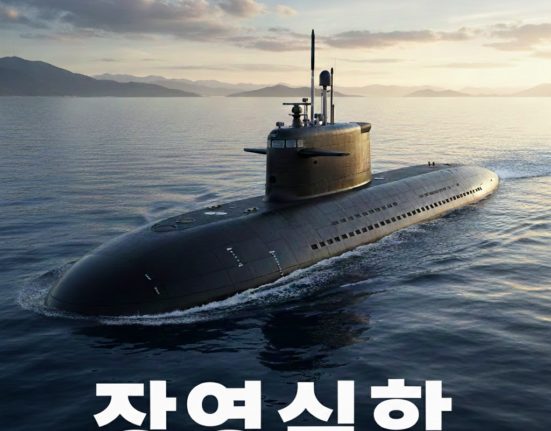
[Chungraon = Associate Editor-in-Chief Dongseop David Yeo] On December 25, 2025, North Korean state media released new photos showing Kim Jong Un inspecting what Pyongyang described as an 8,700-ton-class nuclear-powered strategic guided-missile submarine. The vessel, which appeared to be roughly comparable in size to some U.S. Navy attack submarines, raised new security concerns among analysts and regional observers.
The photos showed Kim inside an indoor construction facility, suggesting that the submarine had not yet been launched or entered service. North Korean state media did not specify exactly when Kim visited the shipyard, but the images showed what appeared to be a largely completed hull still under construction.
Kim first listed a nuclear-powered submarine as one of his major military goals in 2021. The issue has gained further attention since late October 2025, when U.S. President Donald Trump said he had approved South Korea’s plan to build nuclear-powered submarines. North Korea has strongly criticized that plan, portraying it as a threat to its security and maritime sovereignty.
Nuclear-powered submarines have several major advantages. One of the most important is endurance: unlike diesel-powered submarines, they do not need to surface or snorkel frequently to recharge batteries. Their underwater endurance is limited more by food supplies, crew needs, and maintenance than by fuel. They are also generally faster and can operate over longer distances, giving them major strategic and operational advantages. However, it is more accurate to say that they provide greater operational stealth, rather than that they are always quieter than diesel-powered submarines.
Only a small number of countries, including the United States, Russia, China, France, the United Kingdom, and India, operate nuclear-powered submarines. North Korea has not yet joined that group, since its submarine has not been publicly confirmed to be completed, launched, or operational. If Pyongyang succeeds in completing and operating the vessel, however, it could add a serious new dimension to the military threat it already poses to South Korea, Japan, and the wider region.
Kim stressed the importance of such weapons in strengthening his country’s military power. According to North Korean state media, he described “super-powerful offensive capability” as the best shield for national security and argued that the submarine would play an important role in modernizing and nuclear-arming North Korea’s navy.
The report also criticized South Korea’s own nuclear-powered submarine plan, saying it threatened North Korea’s security and would increase military tensions on the Korean Peninsula. However, outside experts have also criticized Pyongyang’s weapons buildup, arguing that North Korea’s own nuclear and missile programs are a major cause of the current arms race. Leif-Eric Easley, a professor of international studies at Ewha Womans University, said that while a buildup of nuclear-powered submarines could increase instability around the Korean Peninsula, Kim “has himself to blame for the arms race.”
Kim has overseen a major expansion of North Korea’s weapons programs in recent years. His five-year military development plan, announced in 2021, called for strengthening the country’s nuclear and conventional forces while increasing North Korea’s ability to project power around the Korean Peninsula.
/Dongseop David Yeo

1 Comment